A Human Was Here
For several years, my wife and I have been wanting to move to a different house. We’ve been in various stages at different times and have even made a few offers. But, as with most things, we finally had to just give ourselves a deadline and start making it happen.
So, we texted our realtor and told him we wanted to list our house in two weeks. Ever since, we’ve been racing the clock to get it all done…and there’s always more to be done. Apparently, you don’t have to live in a home for too long in order to accumulate a lot of unnecessary stuff or to defer a lot of necessary projects.
Thus began the chaos.
Fix What’s Broken
The first thing to tackle was dealing with all the things we’d avoided for years. The drywall I patched and never repainted. The room with the ugly paint color we learned to ignore. The contractor-grade boob lights we always wanted to replace and never did.
It can no longer be ignored…so we started fixing things. And of course, most of it turned out to not be that hard. And after each one, I found myself thinking “why didn’t I do this a long time ago…”
There’s something completely ridiculous about waiting to get your house exactly how you want, just in time to hand over the keys to someone else. But there’s also something deeply satisfying about it. Each repair closes a tiny loop in your brain that’s been running on repeat for years.
Besides, if I’m leaving a place, I want to leave it better than I found it. (totally unrelated, but, if the previous owner of my current house reads this…you really need to learn how to tape a straight line before painting)
Edit, Edit, Edit
Once the broken shit is taken care of, the staging begins. This is when your Marie Kondo angel appears on your shoulder and starts talking. And no, a lot of this stuff does not spark joy.
You clear the countertops. You sort the stack of mail. You remove furniture from rooms. You finally put the once-used air fryer out of sight.
You basically make it look like you live here…but you have serious, obsessive qualities that need professional treatment.
You now have piles of Trash It / Donate It / Sell It / Incinerate It.
And surprisingly, it works. The rooms start looking larger. The space feels more usable. Your subtraction has created focus. And once again, there’s a mental relief when you realize all the physical stuff you accumulated came with a level of mental clutter too, and you just watched both disappear on a donation truck.
But the process has a stopping point. We’ve probably walked through two dozen houses over the last year, and something I’ve realized is how much less I enjoy walking through the ones that look like no one lives, or has ever lived, there.
Signs of Life
The conventional wisdom is to strip all personality away so that potential buyers can imagine themselves living there. I get it. I don’t want to walk through a house and make a mental list of all the things I’d have to undo to make it work for me.
But I also couldn’t care less about seeing another massive coffee table book that I know, with absolute certainty, nobody has ever cracked open. I don’t need another petrified wood bowl sitting alongside three other completely useless objects with the sole purpose of occupying a shelf.
I want to see signs of life.
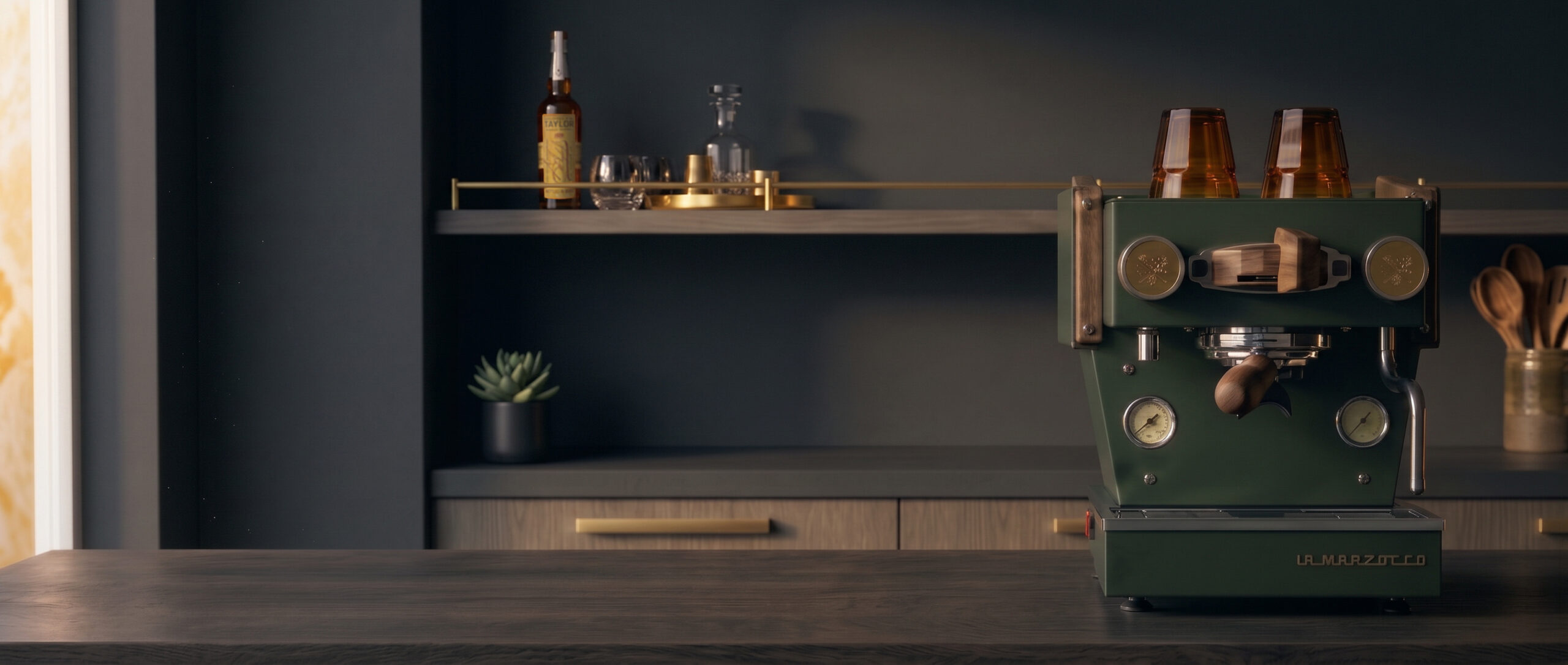
I want to see the espresso setup that shows me they were really into coffee. I want to see that bottle of E.H. Taylor so I can think, Nice choice. I want to see a living room, dining room, or kitchen that looks like good times were had there.
People were happy here. I could be too.
So that’s become the goal with our own house. Not to remove what makes it ours, but to edit it. Fix what’s broken, remove what’s distracting, keep what makes it feel alive.
Which, it turns out, is not unlike my day job. Good design works the same way. So does art direction. So does creative direction. We’re constantly deciding what stays and what goes. What distracts and what draws in. What’s a blemish and what’s character.
The goal is never to remove every opinion, idiosyncrasy, or detail until it’s so safe nobody could possibly dislike it. The goal is to make the important things easier to see. Remove the distractions, give the important things room to breathe, but leave a few fingerprints behind.
After all, a human made this.
Totally unrelated, but if anyone needs 3 lightly-used lamps, 2 handmade end tables, or a set of tableware with only 1 spoon missing, please let me know.
Scott is the Digital Design Director at FoxFuel Creative. He'll provide you with seven pages on how to make the best cup of coffee but only one sentence on his impressive music career.